The power of sandplay therapy — psychological and neurobiological benefits

Sandplay therapy is one of the most effective ways of working with children and adults who have lived through stressful and traumatic experience, or who want to make sense of and transform their emotions and behaviour. One of the many reasons is that it offers an expressive and projective approach, which automatically provides the therapeutic distance needed to work with material bound up with pain and chaos. To clarify: a projective approach uses a method capable of revealing inner conflicts and emotions from the past that are “hidden” in the unconscious, and that can shape a person’s actual behaviour, moods and attitudes beyond their control. The sand itself, and the play within it, also offer a deeply sensory experience that can help someone in distress and crisis. The benefits are at once psychological and neurological — but first, a few words about the true nature of trauma.

Trauma occurs when a vast amount of stress exceeds a person’s capacity to assimilate and integrate the emotions the traumatic situation provokes. This leads to sensory overload at the moment it first occurs, prompting an unconscious avoidance of any attempt to relive the situation. Trauma also causes abnormal activity in the limbic system, part of the central nervous system responsible for emotion, memory and the instinctive behaviour bound up with self-preservation. In other words, during a traumatic experience the brain responds emotionally first, before it can engage its “thinking” part in the cortex. This obstructs verbal expression and the ability to break free of negative emotion, causing a person to overreact and at times to seem threatening to others.
For a painful experience to be worked through in the psyche — rather than pushed into the unconscious, where it blocks the psyche’s self-regulating function — it must be recalled and, to some extent, lived through again. The difficulty is that this inner process reduces the capacity to put things into words and to assimilate the information through thought alone, making verbal expression, whose centre lies in the left hemisphere, nearly impossible. Traumatic experience, by contrast, is stored as bodily sensation and imagery embedded in the right hemisphere, which governs the non-verbal, the metaphorical and the intuitive. This means trauma cannot be treated through wholly verbal approaches; on the contrary, its sensory nature makes it especially suited to expressive intervention — play, creative activity and the arts.
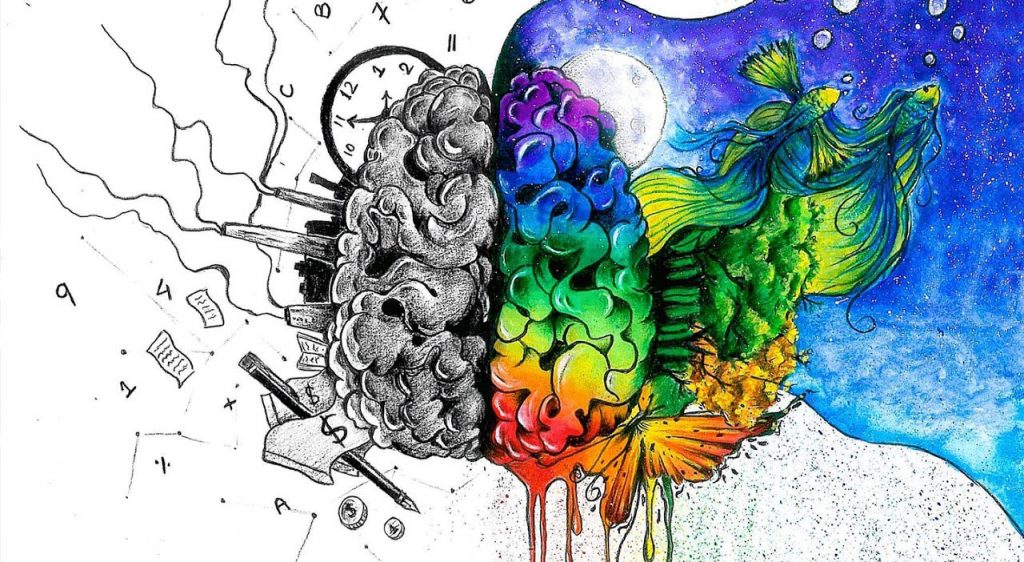
Sandplay therapy rests largely on play with miniature figures in sand, and on telling the story of the world created in the tray. As the symbolic world unfolds into words, the limbic system and the cortex are activated at once, engaging both hemispheres. In this way therapeutic work with sand helps a person express in the outer world the creations of their inner one — including the difficulties of lived experience — and allows mind and body to process it all. Using symbolic language and metaphor in this way can help bring soul, mind and body into balance, encouraging insight, healing and change in the psyche.
All of this makes sandplay therapy well suited to work with children and adults who struggle with stressful situations, traumatic events and powerful emotions such as pain and grief — feelings they have not managed to express outwardly, and which over time gradually block the psyche’s natural self-regulating processes.
Continue with another article

Synchronicity and reading the signs in life
Read
On forgiveness and self-awareness
Read