What is astrology, and why does it go so well with psychology?

One definition of astrology is the process of interpreting the meaning of observable correlations between human experience and the positions, relationships and cycles of the planets in the solar system, including the Sun and the Moon. The movements and positions of these bodies along the ecliptic — the line formed by the Sun’s apparent path over the course of a year — carry symbolic meaning in the zodiac. The imaginary zodiacal belt formed by the ecliptic is divided into twelve segments of thirty degrees each, which make up the familiar twelve signs. Every sign belongs to one of the four elements — fire, air, earth and water — giving three signs to each set of elemental qualities. The fire signs (Aries, Leo and Sagittarius), for instance, are considered warm, energetic, enthusiastic, inspiring and often extroverted, while the water signs (Cancer, Scorpio and Pisces) are seen as emotional, sensitive, empathetic, deep and usually introverted. The qualities of each sign colour the astrological meaning and the principles associated with each planet as it passes through them. The planets, in turn, carry symbolic meanings describing particular dynamic principles and energies. C. G. Jung compared them to gods and archetypes, and described the signs as modes of being, or archetypal styles manifested in enduring traits of character. Until the end of the eighteenth century, traditional astrology used only the seven planets known since antiquity — the Sun, the Moon, Mercury, Venus, Mars, Jupiter and Saturn. Following the discovery of the modern planets — Uranus, Neptune and Pluto — contemporary astrology works with the symbolism of ten.
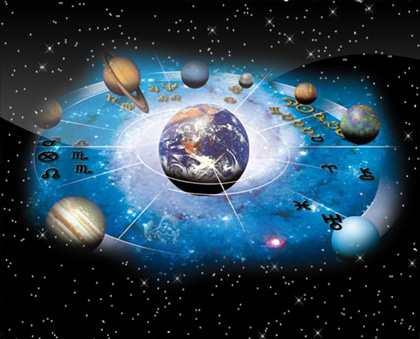
The solar system, as the name suggests, is heliocentric, but astrology uses a geocentric frame: the planets are observed from the point of view of the Earth, simply because human lives unfold on Earth and not on the Sun. From this geocentric perspective, each planet appears to pass in turn through every sign of the zodiac. At any given moment each planet stands in a particular sign, forming a configuration of relationships with the others across the full 360-degree circle. This is called an aspect. The principle behind aspects comes from the mutual influence of any two bodies in space, with the difference that in astrology a specific distance between two planets carries a specific set of influences. When two planets appear within about ten degrees of each other, the aspect is called a conjunction, and it effectively blends the qualities and principles of both into a powerful, dynamic bond. Beyond conjunction, planets form particular angles to one another. When two planets stand on opposite sides of the zodiacal circle, roughly 180 degrees apart, they form a strong, challenging and often antagonistic relationship called an opposition. In the same way, ninety degrees apart forms a square, 120 degrees a trine, and sixty degrees a sextile. These are the major aspects, so called because their effects appear more evident than those of the minor aspects, which this article will not go into.
Besides the Sun’s yearly journey through the zodiac, astrology also takes into account the earthly experience of its daily movement across the sky, produced by the Earth’s rotation on its axis. The line of the Sun’s motion over a full day forms a circle divided into twelve parts known as houses, each representing a different area of life. The first house, for example, relates to our outward appearance, the way we perceive the world and the way we approach it. It begins at the point where the rising Sun appears on the eastern horizon, determining the sign that governs it — the ascendant. The same principle determines the descendant, the start of the seventh house, which begins as the Sun sets on the western horizon; the Midheaven, at the highest point of the circle, like the Sun at noon; and the Imum Coeli, the lowest point, describing midnight. Astrology involves a great many variables, both in number and in complexity, but the ten planets, the twelve signs, the twelve houses and the aspects are widely accepted as the most important factors in interpretation.
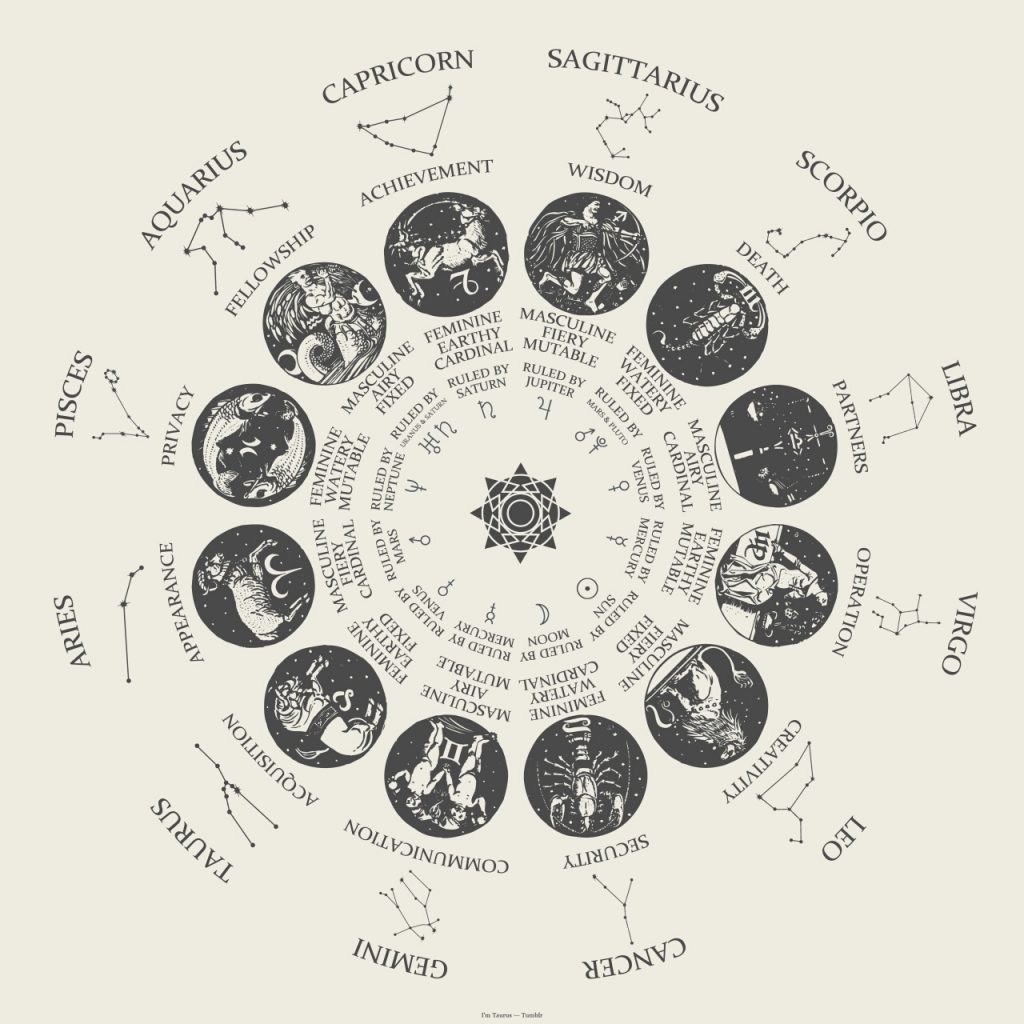
Beyond the newspaper horoscope columns, which rarely deserve anyone’s trust, the most popular form of astrology practised today is natal astrology, based on the moment of birth. Working from the relative positions of the planets at that exact moment, the astrologer interprets the various factors in the birth chart in order to draw a portrait of the person’s character and, in some cases, of their biographical experience. This is why a good knowledge and understanding of the contradictory qualities of every element of the zodiac is essential. Even so, many astrologers — depending on their own experience and their perceptions of themselves, the world and other people — offer interpretations that are far too one-sided. In doing so they deprive the client of the whole picture and steer them towards a particular way of acting, relating and seeing themselves. For this reason, an astrologer’s deep self-knowledge and a sound grounding in psychology are fundamental to the encounter with a client and to giving an interpretation of real value.
It is no accident that psychological astrology, or astropsychology, is increasingly used. Its aim is to reveal the energies at work, the traits of character, the motivations and the way a person experiences the different aspects of life. More importantly, astropsychology takes into account both the conscious and the unconscious sides of the psyche, and seeks to help bring them together into a single, complete whole. Every sign, planet, house or aspect in astrology is a two-sided unit, forming a contrast between two opposing poles. It is no secret that the human psyche tends to divide things into good and bad, loading them with judgement — but this entirely subjective process makes it impossible to grasp the true nature of the contrast. In the end, every concept in astrology has both a light and a dark side, and a deep knowledge and skilful handling of both can bring us valuable understanding and insight into life and into ourselves. To close: the astrological birth chart is symbolic of the structure of a person’s character, and working with it as a symbol turns it into an instrument of psychological growth. As Jung put it: “Astrology is the projected psychology of the unconscious…”
Continue with another article

Between Matter and Love: an astropsychological reading of the myth of the abduction of Persephone
Read
The polarity of human consciousness in the six astrological axes, part II
Read