Between Matter and Love: an astropsychological reading of the myth of the abduction of Persephone
What qualities does the sign of Taurus carry in the myth?
The opposition between Taurus and Scorpio forms what astrology calls the axis of Possessions (more on this in The polarity of human consciousness in the six astrological axes, part I). Taurus is an earth sign and as such governs everything that can be seen as material possession — from objects and people (most often family) to the body itself, which our soul inhabits. Taurus is also held to rule all the traits someone “possesses” and that define them as a unique combination of qualities. It is bound up with pleasure and with the things that bring delight to the senses, and its bodily nature is most closely connected with nature and with all the goods nature brings forth as matter. Taurus likes its eyes to rest on combinations of shape and colour that please them, its palate to taste flavours balanced against one another, its body to touch and be touched so as to feel physical pleasure. Ruled by the planet Venus, it is the embodiment of what the French call “le bon vivant” — one who lives well — drawing on the full potential of the senses of the body and turning pleasure into the highest value and meaning of life.
The myth of Persephone begins exactly there, in the pure expression of this earthy sign oriented towards the delights of matter. Persephone — or Kore, as she is first called — is a goddess of fertility (Taurus) and the daughter of Zeus and Demeter, goddess of the earth and the harvest. She stands at the threshold of maturity but is still inexperienced, carefree and endlessly attached to her mother. Her mother’s protection brings her the calm and safety in which to live peacefully a life on the surface — knowing only pleasure and agreeable feeling in the female company of her mother and her maiden friends. At first glance this idyll fully satisfies Demeter and Kore, and is therefore stable in time — until Aphrodite (Venus) perceives something endlessly artificial and flat in the maiden’s attitude to life. Her intervention in this story is no accident, since Venus, besides ruling Taurus and Libra, is connected with the capacity to love and with the sense of inner and outer worth. She decides to place the naive girl in a situation that will draw her out of her comfort zone (Taurus), offering her the temptations of love in another form, beyond that of the symbiotic bond between mother and child. And so she sends Eros to strike Hades (Pluto), god of the underworld, with one of his arrows, so that he falls in love with Kore.
What qualities does the sign of Scorpio carry in the myth?
In astrology Pluto is the ruling planet of Scorpio and is connected with the most shadowed aspects of our psyche — those so unpleasant, or rather so unacceptable, to human consciousness that they are usually pushed automatically into the darkness of our own unconscious underworld. In Greek mythology, the kingdom of Hades is where souls go after meeting death. In the language of symbols, this means he is connected with transformation — the process in which something old departs and something new takes its place, or more precisely in which one nature changes into another. The underworld Pluto rules is a place of passion and strong emotion, which most people would describe as unpleasant, and whose effect is usually destructive and gives the feeling of death. This, however, is a symbolic death, after which nothing will be as it was — because it burns away everything old, unnecessary and untrue, carrying with it the potential for transformation and renewal.
The meeting of the two signs, Taurus and Scorpio
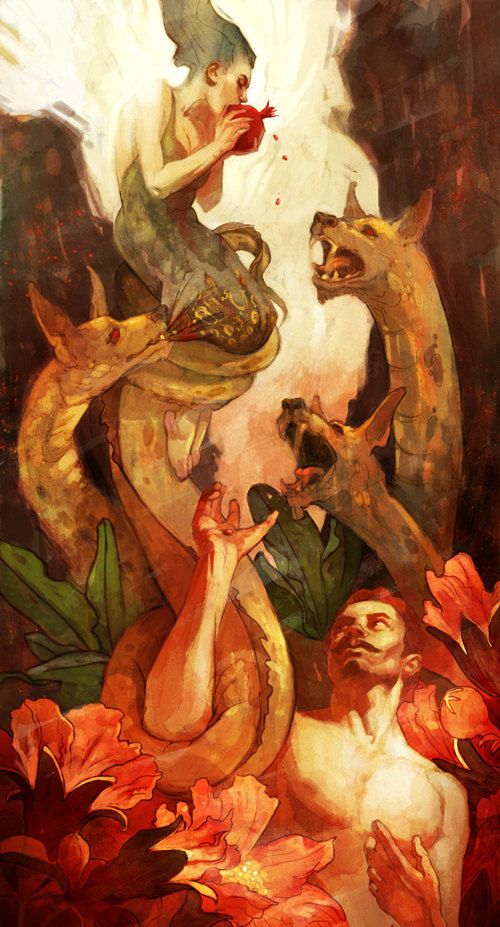
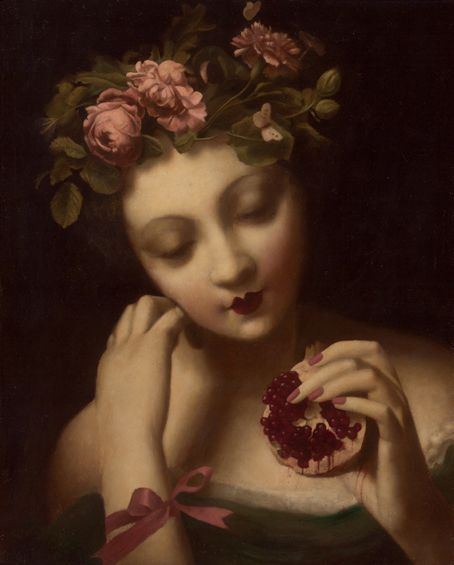
Back to the story: on a sunny, bright day, while playing in the meadow, innocent and content among her friends, Kore notices a narcissus and wanders away from her company to look at it more closely. She is captivated by its beauty and does not even suspect that it is connected with the underworld when she decides to pick it. In the next instant the earth opens and out of its depths bursts Hades on his chariot, carrying the unsuspecting Kore off into the darkness of his kingdom. This is the moment in the story when the maiden’s life, unfolding along the themes of Taurus, turns through 180 degrees to meet its opposite: the experiences belonging to Scorpio. In emotional terms, she meets her shadow side in the form of despair and grief at the loss of her freedom, and afterwards of true and deep love for another — the kind that brings with it, among other things, feelings such as anger, jealousy, envy and insecurity. Below, she tastes six pomegranate seeds whose deep red hints at the loss of her innocence and her entry into the deep emotional world of sexuality — another theme belonging to Scorpio and its ruler Pluto. In the myth, taking food in the land of the dead means she cannot return to the world above. From this moment on, Kore (the maiden without a name) becomes Persephone, she who loves the darkness, and turns into queen of the underworld.
Finding a balance between the opposites
Meanwhile Demeter, maddened by the loss of her daughter, falls into a deep rage followed by grief, which brings eternal winter upon the earth. People lose their harvest and are left without food, and the gods of Olympus are left without sacrifices in their name. This moves Zeus to a decision that will appease Demeter: he orders his brother Hades to release Persephone to her mother for six months, as many as the pomegranate seeds she swallowed. So in the first half of the year, when Persephone is with her mother, it is spring and summer, and the sun shines on the earth from high above, bringing nature into full bloom. In the second half, in autumn and winter, she leaves Demeter and stands beside her husband as queen and goddess of the land of the dead. It is worth noting that at a certain point in the history of ancient Greece the Eleusinian Mysteries grew up around this myth as a leading religion, in which people celebrated each year the return of the goddess of fertility to the world above and the renewal of nature after a long winter.
The shadow side of Taurus in the myth
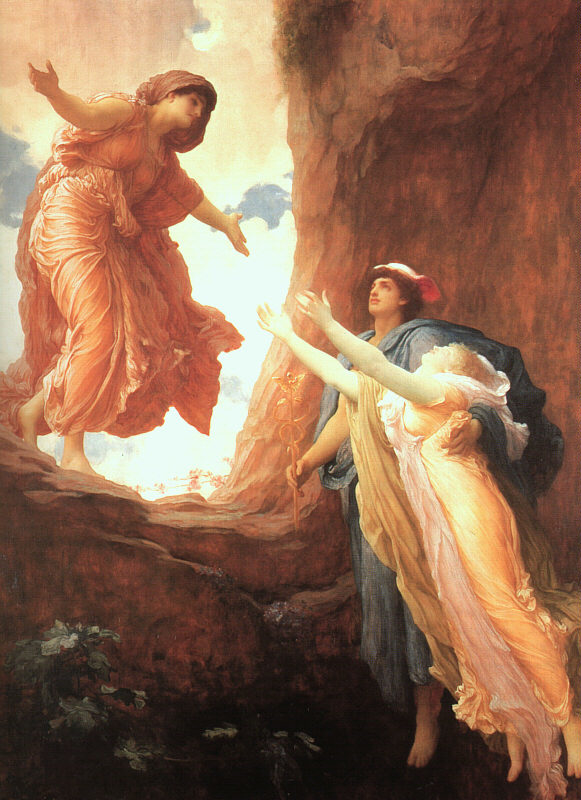
The myth of the abduction of Persephone is an archetypal story in which countless women see their own reflection, because it tells of the passage from childhood to maturity and of the emotional path travelled in coming to know oneself and reaching greater inner wholeness. On one side it presents life on the surface, in the light of consciousness — the life many of us live as children — full of earthly pleasure and freedom from care. This is the world lived along the themes of Taurus, and its shadow side is embodied in the goddess Demeter, through a mother’s sense of possession over her daughter and the artificial holding on to “things” in life, remaining in the comfort zone when the time for change has already come. Their relationship at the start of the story is a relationship of dependency, in which the mother takes full responsibility for her child and cares for her to the point of eliminating any possibility of pain, giving her what looks like a dream life. Persephone, for her part, has no sense of herself or of her own needs, and instead plays the role of an extension of Demeter, as though her only task in life were to bring her mother joy.
The lessons of Scorpio and the potential they carry
The archetype of Persephone is that of the woman in relationship, for first she is her mother’s daughter and afterwards her husband’s wife. She is like a chameleon, changing according to others’ expectations, since she reflects perfectly the projections of whoever stands before her, giving them what they need to “see” in order to feel — however illusorily — more whole. Before her abduction, Persephone has no sense of the solidity of her body, of its sensuality and sexuality — so much so that, in order to meet this side of herself, she is “taken by force” in the myth. Although she enjoys male attention, she lacks passion and depth, as if her body had no substance or content; and before her stands the task of building an independent sense of self, beyond the passive role she plays in her relationships.
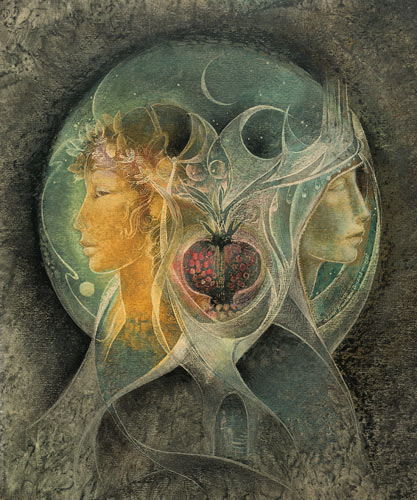
In order to connect with her body and awaken its sensual nature (Taurus), she is set against her will before the archetypal figure of Pluto, so as to dive into the depths of her unconscious (Scorpio), which are revealed through her love for him. The symbolic meaning of the underworld is that of the deeper layers of the psyche, where our unconscious complexes, feelings, images and fears lie “buried”. This journey downwards can happen of our own will, within an analysis, when such content becomes accessible to consciousness through dreams. Whether we wish it or not, however, each of us sooner or later descends into our own underworld, where we must meet the feelings that overwhelm us when outer circumstances arise — the loss of a loved one, or of a profession. The activation of the Persephone archetype, who lives in both worlds, usually gives a woman the ability to dive into her own unconscious and into that of others (much like a therapist), and to mediate between the world of matter and the world of dreams and symbols, revealing endless potential for healing and growth.
During Pluto transits, a person often meets, unwillingly, the underworld of their own destructive emotions, which awaken only in an intense sexual and loving relationship (Scorpio). This happens because each of us then sees — projects — our lost Paradise, in which the other fulfils our endless wishes, much as in the mother–child bond; and even the smallest departure from our expectations brings us to rage, despair and insecurity. In the myth, Pluto shows clearly that he has wishes of his own and, unlike Persephone, does not want to dissolve into the relationship with his beloved — thereby prompting her to do the same, to come to know herself and her own desires in depth.
Reaching a state of love and inner wholeness
What the energy of Scorpio teaches us is the transience of feeling and the potential to change and become more whole, since love is not a feeling but a state of connectedness with the Other and with everything around us. When a person wants to keep only the pleasant emotions in a relationship and is unwilling to leave their comfort zone (Taurus), they block the flow of feeling within themselves and hold the relationship at an utterly surface level, where there is no life, because there is no real emotional exchange. The state of being in love, and the sense of a kind of Paradise, are not something that can be held on to through demands upon a partner. At best, when the (unpleasant) feelings in a relationship are not suppressed or dismissed, they naturally give way to one another, so that a person may come to know themselves — and in this way they become a path of growth for both partners.
And so, at the end of the story, all three archetypal figures accept (through their agreement) the transience of their relationships and of the feelings they hold for one another. Each must meet the joy and euphoria that overtake them in the moments shared together, and afterwards each must accept the loss, the anger, the grief and the insecurity of the rest of the time. This dynamic in the emotional world of relationships plays out before our eyes every year, through the turning of the seasons and the natural cycle of birth, death and renewal in nature — much like what happens within us.
Anatomy of transformation
The heart, the soul, and the fruit.
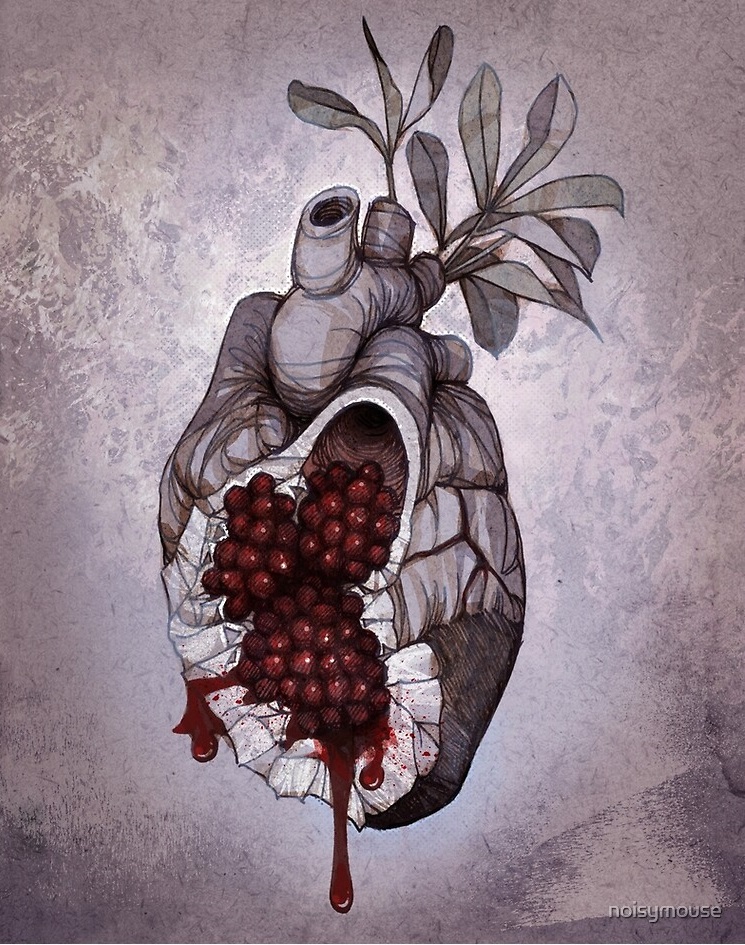
Pomegranate seeds, filled with blood —
the blood of life, small pieces of love.
We build, we break, and then we laugh again.
Yet we feel so deeply
only once sorrow turns towards us
and sinks us in its green waters,
until it burns the last shred of shadow in us.
A heart as vast as a globe,
and we guard it, frozen in fear.
The fear of feeling, by chance,
what life offers us in pomegranate seeds.
And carries in its red and merciless juice
the magic called love, and a pinch of passion.
Love, sorrow, and then love again…
How fiercely they merge in the dance of a deep change.
And a time will come when nothing else remains
but to hold tightly in our hands
that which can only flow and never stay —
like time, like love, like sorrow.
In the heart, in the soul, in the pomegranate…
And to feel life fiercely
… and death and life and death,
fused forever together in the dance of love.
S. K.